Double elimination pickleball bracket, explained
Updated 30 October 2026
Double elimination gives every team a second chance: a team is out only after its second loss. Teams start in the winners' bracket; a first loss drops them into the losers' bracket, where they keep playing until they lose again. The two bracket winners meet in the grand final, and if the team from the losers' side wins it, one more game, the bracket reset, decides the title. It takes about twice as many games as a knockout, and in return nobody's day ends after one bad game.
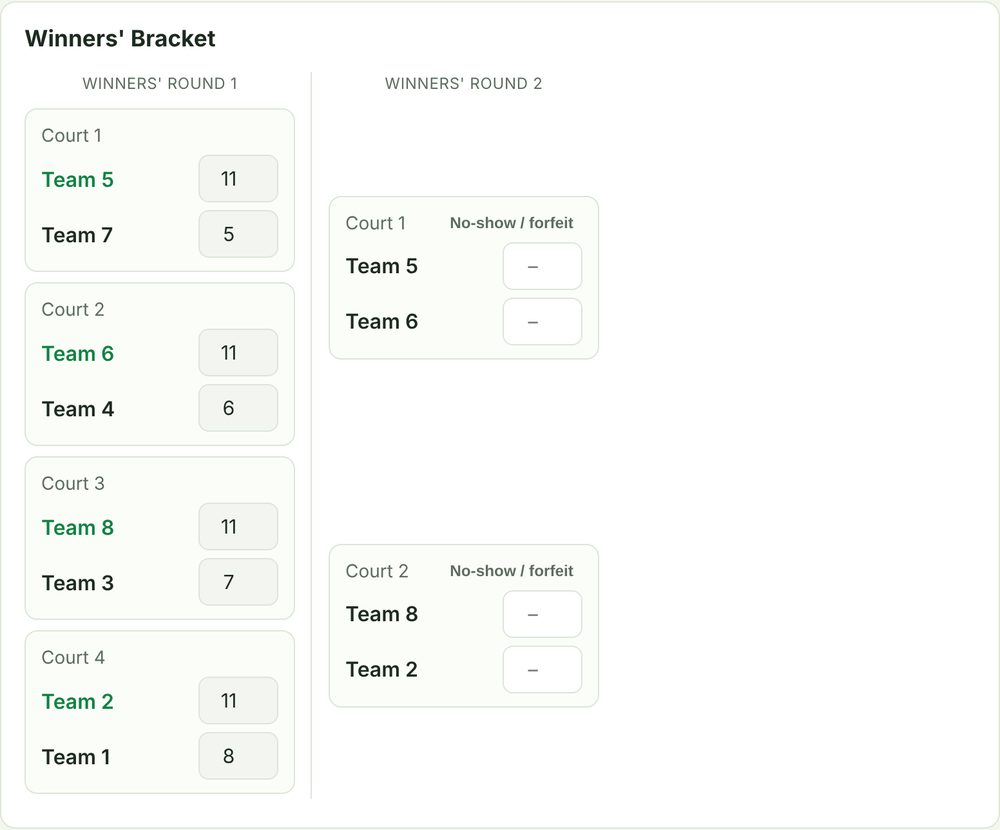
How the two brackets fit together
- Winners' bracket. It runs exactly like a knockout. Winners move on; nobody is out yet.
- Losers' bracket. Every team that loses in the winners' bracket drops in here. Losers' rounds alternate between two kinds: rounds where the teams already in the losers' bracket play each other, and "drop" rounds where they meet the teams that have just fallen from the winners' bracket. A loss here is a team's second, so it is out.
- Grand final. The winners' bracket champion (no losses) plays the losers' bracket champion (one loss).
- Bracket reset. If the winners' champion wins the grand final, it is over. If the losers' champion wins, both teams now have one loss, so a second final is played. Some events skip the reset to save time; if you do, announce it before play starts.
Games, rounds and time by field size
| Teams | Games | With reset | Fewest games a team plays | Most a team can play |
|---|---|---|---|---|
| 4 | 6 | 7 | 2 | 5 |
| 6 | 10 | 11 | 2 | 6 |
| 8 | 14 | 15 | 2 | 7 |
| 12 | 22 | 23 | 2 | 8 |
| 16 | 30 | 31 | 2 | 9 |
The game count is always 2 × teams − 2, plus one if the reset is played, because every team except the champion loses exactly twice, and the champion loses at most once. The "most games" column is the team that drops into the losers' bracket in round 1 and fights all the way back to win the title.
Time is set less by the number of games than by the longest path. The losers' bracket has about twice as many rounds as the winners' bracket, and its rounds can't start until the winners' round that feeds them is done. For 8 teams on 4 courts, plan on about 9 rounds of play, roughly 2 hours 15 minutes with games to 11. On 2 courts the same event takes closer to 3 hours, because the early rounds run in waves.
Byes and seeding
Brackets work in powers of two: 4, 8, 16, 32. Any gap is filled with byes in the first winners' round, and byes go to the strongest seeds. A good bracket also keeps byes from piling up in the losers' bracket. PicklePairings gives a losers'-bracket bye to the team that has had the fewest so far, so no team gets two easy rounds while another gets none.
Seed from something real when you can: last season's standings, a ladder, a round robin played earlier in the day, or DUPR ratings. With no information, a random draw is fine. Put the top two seeds in opposite halves so they can only meet in the final.
When to choose double elimination
- Choose it for a club championship, a final day after league play, or any event where people travelled to play and one loss shouldn't end their day.
- Choose a knockout when time is tight. Same number of teams, half the games.
- Choose a round robin for 4 to 8 teams when everyone should play the same number of games.
- Choose a Swiss for 10 teams or more when you want a full ranking without eliminations.
Running it on the day
- Post the bracket before the first serve, with the reset rule written on it.
- Call games by court as soon as both teams are known, rather than waiting for the whole round. The losers' bracket waits on the winners' bracket, so keep courts moving.
- Keep the score of every game, not just who won. Scores settle seeding questions and look good in the final standings.
- Be clear about forfeits: a team that withdraws loses its remaining games, and its opponents advance.
Double elimination in PicklePairings
Pick Double elimination, enter the teams and build the bracket. The app draws the winners' and losers' brackets side by side, sends each loser to the right losers' round, spreads byes, and builds the next round by itself as soon as the last one is decided, including the grand final and the bracket reset when it's needed. Earlier rounds lock once a later round depends on them, so a typo can't quietly change who advanced. You can share a live link so players follow the bracket on their phones.
Questions
How many games is an 8-team double elimination?
14 games, or 15 if the grand final needs a bracket reset. Every team except the champion loses twice.
What is a bracket reset in double elimination?
If the losers' bracket winner beats the unbeaten team in the grand final, both have one loss, so a second final is played to decide the title.
Is double elimination fair to the losers' bracket team?
It plays more games, but it only needs to win the final twice because its opponent has not lost yet. That is the price of its earlier loss.
Can you skip the bracket reset?
Yes, many casual events do to save time. Decide before play starts and tell the teams, because it changes who is favoured in the final.
How long does an 8-team double elimination take?
About 9 rounds of play. With games to 11 on 4 courts, plan around two and a quarter hours; on 2 courts, closer to three.
Run a double elimination in PicklePairings
Enter the teams; the app builds both brackets, the grand final and the reset, round by round as scores go in.
Open PicklePairings